Thursday, 12 December 2019

THE PRESENT. THE PAST. THE FUTURE

A REPORT

THE DECCAN VOICES
at Vidyaranya School – 8th December 2019

     And when the night is cloudy, there is still a light that shines on me,
shine until tomorrow, let it be. 'Let it be'. The Beatles
     Before the morning's music began, Joe Koster who hosted the programme announced his farewell to Hyderabad. So, this concert was his farewell gift to the city in which he and his wife Ines had loved to live in for so many years.
     He then called for one minute's silence in memory of Vijay Marur, the prominent member of the twin cities cultural environment and trustee of the Hyderabad Western Music Foundation.    
      Music is the magic through which the present is celebrated, the past is remembered and the future is welcomed
     What a lively bunch of singers they are, these 'Deccan Voices'! An individual singing is hard enough, but it is even more difficult for sixteen voices to sing together in harmony, singing different parts and yet keeping the beat, staying in tune and enlivening the music by synchronising their voices, articulating words and modulating volume - the Deccan Voices did all this really well, blending smoothly in one voice. 
     And what an enjoyable selection of music they presented to give our day a good start! The Deccan Voices choral ensemble conducted by Joe Koster and accompanied on piano by Jay Parthe and Clayton Sheehan on guitar regaled us in the audience with spirited singing in good voice and perfect harmony, singing songs by ABBA from the musical and movie 'Mama Mia', a medley of historic Beatles songs, they sang Dil Se Re… by A.R. Rehman, 'Africa, by Toto, Bohemian Rhapsody by Queen, and other songs by John Rutter. The men's ensemble sang Happy Together by the Turtles. On two of the songs, Dil Se Re and Africa the ensenble were accompanied by a tabla player, Mathew Peter. 
Celebrating a diversity of musical experiences
     The mornings' programme of music didn't begin and end with the Deccan
Voices. A few of Joe Koster's students performed as well. There was Frederic Chopin's Scherzo in B flat minorplayed by young virtuoso, pianist, Yash Agarwal, who more than played the composition, but interpreted it with intelligent understanding beyond his years. Then there was Schubert's Adagio from Sonata No 8 for viola/pianoplayed on viola by Hema Bojja, accompanied by Joe Koster on piano, 
  where Hema displayed a a good tonal quality on the viola. Mathew Peter, the Tabla player who accompanied the Deccan voices on two songs, then sat at the piano 
and played a composition by impressionist composer Claude Debussy, Prélude no. 4; Book 1 “Les sons et les parfums tournent dans l’air du soir” which he rendered with a sensitively that did justice to the composition.  
     Though not a student, but a professional musician and teacher - guitar player, Ujjal Saha, 
 enthralled the audience with a dazzling jazz guitar solo. His strong technique, the intensity of improvisation and solid rhythmic feel was nothing less than hugely 
impressive. 
    And at last, the pianist, I was personally waiting to hear, was presented, Jay Parthe, the conservatory trained pianist from Mumbai who is now teaching piano in the twin cities, played Bach: Prelude from English Suite no. 2 in A-minor; and he did not disappoint, he respected the structure of this beautiful piece and displayed accuracy and a good understanding of staccato playing in this piece by Bach, his handling with both hands, though he paced it at a moderate speed, allowed the music to flow with rhythmic musicality.
Music celebrates the present, memorialises the past and the welcomes future 
     The new music forum that would take the baton of Western music forward in the twin cities, the Hyderabad Western Music Academy was introduced by Joseph Daniel, a founder/trustee of HWMA who, addressed the audience on HWMA's vision and mission. Raghav Rao is another founder/trustee of the HWMA. Both are members/voices in the Deccan Voices.
     And then, at the end of the morning concert, Raghav Rao, Nandini Rao and Daphne deRebello spoke and commended Joe Koster for his contribution to Western music in Hyderabad and the musical initiatives he had brought to the twin cities. Gifts were given and compliments were exchanged.
     The whole audience wished Joe and Ines farewell, and as Joe said, they leave with a tear in one eye and a smile in the other, the listeners, colleagues, students, fellow members of various organisations that he belonged too rose up as one to wish him farewell with a tear in one eye and a smile in the other for their musical journey in the twin cities, and for their legacy of music that memorialised the past, celebrated the present and the welcomes future.     

Wednesday, 11 December 2019

AMAN MAHAJAN — REFUGE - SOLO PIANO ALBUM

Refuge’ released on 11 December 2019, on Subcontinental Records as a CD, a high-quality digital release, as a limited-edition poster that comes bundled with the digital release, and on all streaming services. 

Photo: Tejaswini Shashidhar

Preview

SEGUEING FROM COMPOSITION TO IMPROVISATION AND BACK.  SEAMLESSLY
     Having heard the pianist, composer and improviser Aman Mahajan live a few times before in different formats—duos, trios, and other ensembles—as leader and sideman, playing an array of musical styles from jazz, new age, contemporary, and his own distinctive compositions that defy classification, it is interesting to note that Refuge, his first ten-piece piano album, also transcends genre, and though it’s his debut solo piano venture, it is still as vibrant and stimulating as his live performances. And, it's cool. It's innovative. It's entertaining. It's rhythmic. It's wonderfully melodic. And it's got depth.
From Aman's notes —
     "REFUGE is a reflective set of musical themes exploring ideas of home and paying homage to inward journeys. A work in progress since 2005, this album is also a musical scrapbook that documents the composer’s life, his exploration of philosophical frameworks, intellectual ideas and personal themes alongside his study of music, and the connections between them".
     "Although created through an intensely personal process, the music deals with the human condition, and finds resonance with listeners across the globe. Equal parts structured and improvised, Refuge has been performed in various configurations, featuring a diversity of instruments. This is essentially a collection of pieces that originated at the piano, travelling across continents on various collaborations, meeting a multitude of musicians and audiences along the way, only to return to the piano in this avatar".
     Aman Mahajan, the pianist/composer is a philosopher. A philosopher-musician and musician-traveller who through his music takes you along on his journeys in the search for the core of human existence, and its realisation.
Photo: Sangeeta Agnes Hosea
Aman's compositions are worthy of attention, they are concept-driven, inspired by both, traditional and contemporary music and influenced by a diversity of musical expressions from around the world. And though his strong, organised and complex compositions are deceptively simple-sounding, his music is that of a canny craftsman. Tricky, but it doesn't show. There's a lot going on in the pianist/composer/philosopher's rhythmically inventive and melodically innovative compositions that clearly reveals his thought process as he applies his distinctive aesthetic, textures, resonance and ingenuity to his thoughtful narratives, which though meditative, are not dense introspections but enjoyable declarations that brim with intellectual energy.
     As a pianist, Aman is indisputably accomplished, easy-going and erudite, seamlessly improvising on these well-designed compositions with his vast interdisciplinary vocabulary contributing to his own musical voice which is without unnecessary puffery and superfluities. And with his solid technique, he ripples through the melodies with sure-fingered poise, insistently repeating his energy-filled emphatic chords while he elegantly segues from the composition to improvisation while maintaining the same sound, emotion and vibrance, and then smoothly segues back to the composition without the listener knowing when he did what.
     The first piece, Where Is It? is a yearning call to seekers — “What are you looking for? Where is it?” It is in the form of a cyclic chant; an incantation of repeated rhythmic phrases. The Ten Thousand Questions is a quest for the one question that would substitute and answer the ten thousand questions. This is an example of Aman's complex, yet simple-sounding explorations, which employs unusual jazz chord progressions and an Eastern-sounding scale. More Than You Know is an interplay between Raag Des and certain harmonic and melodic fragments found in gospel music. It’s a tribute to Boston, the home away from home, where Aman studied music for a few years. Sitaphalmandi, i.e. custard-apple market, is a place in Hyderabad. The rhythm of the first section is based on Dappankuthu, a South Indian folk-dance beat, with the second section loosely based on a jazz waltz. Connections is a subtle and nuanced acceptance of the mystery of the unending cycle of the universe with the main motif repeated like a reflection on itself.
Photo: Luiza Sales
     Beginningless is another circular motif, repeated throughout but reframed by changing rhythms. Leifmotif, a witty misspelling of the word Lietmotif, was inspired by a falling leaf. It is in the rhythm cycle of 7 beats, and the melody is devised from Coltrane chord changes combined with Raga Yaman. Where Is It? (reprise) // Refuge begins like an alternative take of the first tune, with melodic and rhythmic variations on the theme. Unnamed is the only live recording in this album, recorded in Graz, Austria. Aman shows his strong sense of how to frame his soloing. We find no difference in Aman's focus and performance in his live recordings from his first solo studio recording. Sun Dance with its catchy melody line and constant rhythm is an attractive composition that raises your spirits and makes you want to dance.  
     The music on this album defies genre. Composed between 2005–2018 the tunes synthesise jazz, Indian music, European classical music, East Asian themes, West African music, and folk music from around the world. The music is engrossing, whether you are, or are not, a fan of classical music, jazz, or world music, the music is sure-footed, entertaining and engaging as each tune goes forward, layer over layer. On top of that, it's been recorded and mixed so well, with a perfect tonal balance that sounds true and immediate.

You can follow the album and artist on amanmahajan.bandcamp.com

More Than You Know

Refuge 

The Ten Thousand Questions - Trio

Sun Dance

Monday, 25 February 2019

KODAIKANAL INTERNATIONAL SCHOOL, ORCHESTRA, BAND AND CHOIR


QUALITY PERFORMANCES BY GIFTED STUDENTS

A great variety of music, from western classical, to pop, was heard at the concert by the Kodaikanal International School, held at the St Mary's Degree College Auditorium, on the 23rd of February 2019. 

And, the music was performed at such a respectable degree of proficiency by all the students, in all the different formats, that it was only because we were in the audience and could see for ourselves that they were young students playing and singing, that we could believe our ears.

Not only did we in the audience marvel at the musical talent on display at the concert by the students of Kodaikanal International School (KIS for short) and the dedication of their music teachers who, I am sure, played a huge part in training, inspiring and nurturing them, but also, at the school, for giving so much importance and encouragement to the teaching and learning of music, and providing excellent facilities for the pursuit of music, along with academic curriculum. 

We also had to marvel at the school administration, 
to decide to make the trip to Hyderabad. What a logistic feat it must have been for the school administration to arrange for the transportation of all the student musicians and staff, and instruments and equipment from Kodaikanal! 

Kodaikanal is only accessible by a three-hour journey by road from Madurai. They travelled to Madurai, and then to Hyderabad, and back from Hyderabad to Madurai, just to perform for us in Hyderabad! And for us in the audience it was a marvellous experience!   
 
The evening's performance began with the School's advanced orchestra, the KIS Orchestra, of around forty musicians conducted by Sarah, that played a classical French love song, Plaisir D’Amour "The pleasure of love" by composed by Giovanni Martini in 1784, and arranged by Robert Longfield. The piece sounded familiar in some parts as one heard snatches of the song Can't help falling in love that was famously sung by Elvis Presley amongst others. it was good to hear a good orchestral sound from the young orchestra which some teachers also playing in it.

The next piece played was the Johnny Appleseed Suite by Robert Kerr, a suite in three movements and we heard traces of the song Edelweiss from the musical The Sound of Music in this. The orchestra had a good seven or eight-minute workout to show their skill in creating graphic pictures where we could actually imagine the goings-on in the movements entitled, Johnny's planting song, Johnny's prayer and the final Johnny's hoedown, in the hoedown, the fiddlers made the fairground dance music come alive.
 
The next few items on the card were the students performing solos. And whether it was young Mr Jai Mohan Malik on Saxophone showing good tone, clarity and technique on Palotas and Friss by Josef Balogh or Nina Hariharan, who sang the song 'Secret Love" in a naturally melodious voice and handled the rarely heard and difficult-to-sing introduction really well, or Miss Eojin Kim who flawlessly played the Allegro from Handel's Sonata in F on Flute, and made a not-so-simple piece of music sound simple. And Marie Chalard, who played the Boccherini Minuet on clarinet with first-rate articulation. We noted that wherever a keyboard was required, one of the music teacher's, Edwin, accompanied them. Edwin, actually accompanied all the formats of all the various musical items, wherever required, throughout the evening.

The next few items on the programme, were quartets. The Clarinet Quartet played the Rondo from Mozart String Quartet No.1 K.80, The musicians, Aryan Patel, Gershom Nirmal, Marie Chalard and Wangden Dhondup were perfectly precise and the Rondo was good to listen to. They next performed an excerpt from Mvt.1 in G major by W A Mozart 'A Little Night Music' – it was a skillful performance of a beautiful piece of music and it was particularly gratifying to hear the bass clarinet giving depth to the quartet and providing the counterpoint. The Flute Quartet - Seunghyun Im, Sharanjay Pradhan, RaeHannah Balaraju, Eojin Kim, played a short but pretty tune in perfect harmony 'Wild Roses' by Zdeňka Horáčková.

The Deccan Voices conducted by Joe Koster, also the accompanist on piano, rendered an enjoyable version of Freddie Mercury's Bohemian Rhapsody.

The KIS Advanced Choir of about forty student voices and directed by Christina, took the stage to render two tunes from La La Land, 'Another Day of Sun', and 'Someone In The Crowd', by Jay Althouse, arranged by Alan Billingsley, the young choir performed both these tunes creditably.
 
The conductor Christina, who had sung in the Deccan Voices while she lived in Hyderabad, then invited the Deccan Voices to join the KIS Advanced Choir to sing 'City of Stars' from La La Land. 
And the Deccan Voices sang one more song along with the KIS Advanced Choir, the song was the famous Jazz standard 'I'm beginning to see the light'. The combined choir sounded very good, with the mature voices of the Deccan Voices adding depth and volume to the rendering of these songs.     

The KIS Advanced Band, a forty-student band of horns and wind instruments with bass percussion, xylophone and drums, conducted by Joel, played a set of tunes from the Computer animated movie The Incredibles composed by Michael Giacchino and arranged by Jay Bocook.  
The KIS Advanced Band also did Arabian Dances by Roland Barett, in which the clapping sequence came out so well, and the soundtrack highlights of the American superhero film Guardians of the Galaxy, arranged by Michael Brown. All the three of the items were a treat to the ear, and, to see the students enjoying playing these tunes with as much restraint as enthusiasm was a wonderful experience.

And that was the end of a delightful evening of music by the KIS students. It was an evening well spent... in a world of music created by schoolchildren who played and sang with talent, discipline and maturity, like professionals.

The whole organisation of this event was done with discipline and professionalism, and the leader Paul Jaikumar from KIS, who proposed the vote of thanks at the end thanked Joe Koster, The Hyderabad Western Music Foundation, and the Deccan Voices, amongst others, for making this possible, however Joe Koster gave credit where it was due, and gave Paul Jaikumar, Joel, conductor of the Advanced Band, Sarah, the conductor of the Advanced Orchestra, Christina, conductor of the Advanced Choir and the pianist Edwin, memento's and thanked them for coming to Hyderabad and bringing and taking care of the talented KIS students.

Photographs: Joe Koster 


Friday, 26 October 2018

AN ORCHESTRA IS A ‘HOLARCHY’


    While writing a management-type essay about how an organisation could be structured as 
an orchestra is, and, how an orchestra is a perfect example of a holarchy, I adapted it as a standalone essay on the orchestra as a holarchy

WHAT'S HOLON & HOLARCHY
     So what’s a holarchy? “A Holarchy is a ‘Natural Hierarchy’ of Holons”, said Arthur Koestler, who coined the words ‘holon’ and holarchy to refer to an entity that is in itself a whole and is simultaneously part of some other whole.  
     And what’s a holon? A Holon is a whole and a part. Just as a particle is complete by itself and exists by itself but becomes part of another complete entity - an atom, it yet retains its completeness and its identity. A Holon too, is a complete entity which in addition to maintaining its own autonomy as a whole, simultaneously fits in as a part of something else. Its own existence, though complete, depends upon its capacity to fit-in and be part of something else. For instance, a whole atom is part of a whole cell, and the whole cell is part of a whole organism, and so on... in an increasing form of wholeness - from atoms, to molecules, to plants, to animals and to humans. Each of these entities is both a whole and a part - a ‘whole/part’, a Holon.
     A ‘holarchy’ is simply an order of increasing wholeness. For example: particles > atoms > cells > organisms, or, letters of the alphabet > words > sentences > paragraphs. The whole of one level becomes a part of the whole of the next.
     A natural hierarchy, for example is - Date > Month > Quarter > Year.  Or - Cities > States > Countries > Regions > Continents.
     When one says, “the whole is greater than the sum of its parts” that means that the whole is at a deeper or higher level of organisation than the parts alone – that’s a Holarchy!  
     The words Holon and Holarchy that were neologised by Arthur Koestler were examined explored by Ken Wilber in his book “A Brief History of Everything” and it is from this book that I have summarised and rearticulated the ideas of the holon and holarchy.

AN ORCHESTRA AS A HOLARCHY
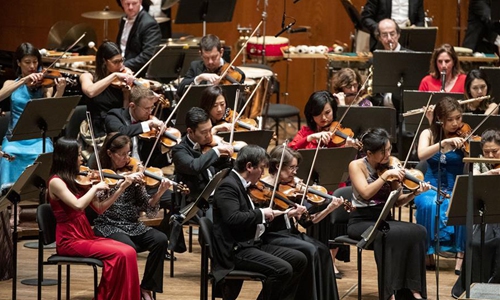
     An orchestra, or a jazz band or a choir are perfect examples of a Holarchy.
     For an orchestra, the score, written in musical notation, are the written rules and guidelines for the part each member of the orchestra sings or plays on their individual instrument to suit the section to which the instrument belongs, and the score is arranged so that all the several different instruments, voices and instrument-groups play their different written parts to blend harmoniously together.
     Each musician, instrument voice and instrumentalist play a specific part which is complete by itself, but which also merges into the section of which it is part, and each section of the orchestra augments and enhances the sound of the whole orchestra. This is what makes an orchestra “a whole that is greater than the sum of its parts”. And this is typical of a holarchy.  
     We will look at how a large group of musicians, is organised and constructed to produce music.  
    A symphony* orchestra is composed of a large group of organized instruments which usually play classical music compositions, and could have as many as 100 musicians in it, and perhaps, in a large 100 piece symphony orchestra, around sixty or seventy would play stringed instruments and the rest would play other instruments. A Jazz band or choir could also have many musicians playing many instruments and have many singers in them. 
     The string section of a symphony orchestra is: first violins, second violins, violas, cellos and double basses. One or two harps may also be part of the symphony orchestra.
     The woodwind section is next - woodwinds are usually composed of flutes (including alto and bass flute), piccolos, oboes (including bass oboe), cor anglais, clarinets, bass clarinet, bassoons and a double bassoon.  
    Then there is the brass section, the instruments which comprise the brass section of a symphony orchestra are the trumpet, cornet, trombone (including the alto and bass trombone), French horn and tuba.
     Percussion instruments - Not all percussion instruments will be included in a symphony orchestra. The percussion instruments are usually the xylophone, bass drum, tympani and piano.
     A jazz orchestra or big band is also an organisation of a large number of musicians who play a variety of musical instruments that play Jazz or any orchestrated music.  


A Jazz orchestra or Jazz band is also divided into sections, for example, Charles Mingus’s big band compositions had a Woodwind section of Alto saxophones, tenor saxophones, baritone saxophones, Bassoon, bass clarinet; and piccolo, flute, oboe and clarinet. 

The Brass section had Trumpets, French horn, trombones, tuba. And the Rhythm section had - Piano, Bass, drums, vibes (vibraharp), guitar, percussion. Sometimes a jazz orchestra or jazz band has a few strings, and occasionally, a symphonic string section to complement the orchestra.


An orchestra exemplifies and illustrates a ‘Holarchy’
     The orchestra or jazz band or Choir is structured so that all are equally important to each other and interdependent. Each voice or instrument is like a Holon, which maintains its own wholeness, identity and autonomy, yet fits in as a part of something bigger than itself. Each voice or instrument is part of a section, like the string section or woodwinds or brass or percussion, yet each plays its own part in the section it belongs to and each section, plays its part according to its role in the orchestra. 
     So, an orchestra is constructed as a Holarchy and comprises equally important independent parts which would increase in its wholeness as it grows. Though each voice or instrument is capable of being a soloist and independent, it is part of a higher level, which, in turn fits into another part at a deeper or higher level of the orchestra, making 
the whole greater than the sum of its parts.  Q.E.D.  
     *A symphony orchestra or a philharmonic orchestra is the same thing, but the words symphony or philharmonic are only used to differentiate orchestras. When there are two good orchestras in a city, one would call itself a symphony orchestra and the other a philharmonic orchestra for e.g. the New York Philharmonic Orchestra (NYPO), founded
in 1842, and the New York Symphony Orchestra founded in 1878, which, till today, entertain discerning audiences with a high quality of music with only their distinctive names to differentiate them.

https://reformcommunications.blogspot.com/2013/10/organisation-as-orchestra-as-holarchy.html


Thursday, 18 October 2018

THE ORCHESTRA - THE CONDUCTORS INSTRUMENT


     “Is he going to beat her up after she stops singing” asked Dennis the menace, seeing a conductor waving his arms frantically while directing an opera singer and the orchestra.
     Conductors have different ways of directing an orchestra, some are very active and use their whole body to conduct, and some are very quiet with minimal movement. 
     Given that every single member of an orchestra is an accomplished musician who wouldn’t find a place in the orchestra if they didn’t reach the highest standards of proficiency in their instrument ... so, a question an audience often asks itself is, what on earth does the conductor do and why do they need someone to direct them and wave their arms at them like a traffic cops
     The answer is: The orchestra is the instrument of the conductor. Just as the instrumentalists in the orchestra are masters at their instruments and play their instrument with mastery. The conductor plays the orchestra as an instrument and is the master of the orchestra.
     An interesting aside - most orchestra’s are known by their name, Like the Vienna Philharmonic Orchestra or the Berlin Philharmonic or the Chicago Symphony Orchestra, or London Symphony Orchestra, except in India, where if an orchestra, let’s say, the Israel Philharmonic Orchestra, visits to play, and if Zubin Mehta is the conductor, then nobody knows the name of the orchestra, they only know that Zubin Mehta played here. The name of the orchestra that he conducted is not remembered. And though, the way Indians see it is not exactly the right way to view an orchestra or a conductor, especially as it is in the case of Zubin Mehta, to most Indians, the conductor is inadvertently, but correctly, known to play an orchestra. 
HARMONY, BALANCE, CONCORD AND SYNCHRONICITY
     Music for orchestras is written in the language of musical notation in the form of sheet music called the score, and the musical score is arranged so that all the several different instruments, voices and instrument-groups play their different written parts to blend harmoniously together. 
     Orchestration is all about harmony, balance, concord and synchronisation. All the instruments in an orchestra harmonise; i.e. they play different but compatible notes that sound good when played at the same time. So, the string section of the orchestra, the first violins, second violins, violas and cello’s play different but complementary notes to produce a harmonised melody. This applies to each section, woodwinds and brass too. And, each section harmonises with each other in a balanced synchronization, entering and exiting at different times to add to the colours and textures of the musical work in accordance with the tonal quality of the group of instruments. This is done in precise coordination and consonance with the rhythm and overall musical conception that has been written by the composer who like a painter, uses a whole pallet of colours, tones and textures through various instruments in the creation of a musical work of art.
THE CONDUCTOR IS THE MUSICAL DIRECTOR  
     Each of the musicians in a big band or orchestra are competent musicians who are expert on their individual instruments, but the conductor or musical director knows every part in the entire score intimately and also has a basic knowledge of every instrument.
     By waving her/his baton and appearing to be a musical traffic director during a concert, the conductor showcases the proficiency of the whole orchestra.   
     The Conductor or Director of music of a music group or orchestra is more than a baton waving time keeper to the musicians. The conductor is a guide, controller and custodian of the music.
     A good conductor has a vision of a piece, and interprets musical works, exposing the artistic quality and distinct features of the music in an insightful and often moving way, contributing to the overall "voice" of the orchestra.
      The conductor leads the orchestra or band through rehearsals and prepares the musical ensemble for public presentations. During rehearsals, the director communicates his/her vision of the piece to the musicians and breathes life into the score, by shaping the whole conception of the music by demonstrating and verbally describing what exactly they need orchestra members to do to get a specific sound or feeling, and by tweaking the structure to create orchestral balance. The conductor rehearses the ensemble by executing specific arm movements to convey the mood of the music.
     The conductor aids the musicians with arm movements, communicating with the musicians in real-time, often with gestures and facial expressions; beginning the piece, cueing musicians and providing tempo reminders and indicating dynamics so they make their entries and exits and go soft and loud at the right time. 
    The way orchestras perform depends on the conducting style, and that’s why the same musical work often sound quite different under different conductors. 
Some conductors in performance are vigorous in their movements and some seem to hint minimally at what is expected of the orchestra. Some conductors allow the orchestra to lead itself and seem to listen and enjoy the music as it emerges. They are facilitators. Some move their hands artistically as if giving shape to the output of the orchestra, guiding rather than commanding. Generally, good conductors allow the musicians - the orchestra, to do what they do best i.e. play. 
     We’ll close with a humorous, yet to my mind, cynical quote from Thomas Beecham, the English conductor and impresario best known for his association with the London Philharmonic and the Royal Philharmonic orchestras ~ “There are two golden rules for an orchestra: start together and finish together. The public doesn’t give a damn what goes on in between.