Thursday, 18 October 2018

THE ORCHESTRA - THE CONDUCTORS INSTRUMENT


     “Is he going to beat her up after she stops singing” asked Dennis the menace, seeing a conductor waving his arms frantically while directing an opera singer and the orchestra.
     Conductors have different ways of directing an orchestra, some are very active and use their whole body to conduct, and some are very quiet with minimal movement. 
     Given that every single member of an orchestra is an accomplished musician who wouldn’t find a place in the orchestra if they didn’t reach the highest standards of proficiency in their instrument ... so, a question an audience often asks itself is, what on earth does the conductor do and why do they need someone to direct them and wave their arms at them like a traffic cops
     The answer is: The orchestra is the instrument of the conductor. Just as the instrumentalists in the orchestra are masters at their instruments and play their instrument with mastery. The conductor plays the orchestra as an instrument and is the master of the orchestra.
     An interesting aside - most orchestra’s are known by their name, Like the Vienna Philharmonic Orchestra or the Berlin Philharmonic or the Chicago Symphony Orchestra, or London Symphony Orchestra, except in India, where if an orchestra, let’s say, the Israel Philharmonic Orchestra, visits to play, and if Zubin Mehta is the conductor, then nobody knows the name of the orchestra, they only know that Zubin Mehta played here. The name of the orchestra that he conducted is not remembered. And though, the way Indians see it is not exactly the right way to view an orchestra or a conductor, especially as it is in the case of Zubin Mehta, to most Indians, the conductor is inadvertently, but correctly, known to play an orchestra. 
HARMONY, BALANCE, CONCORD AND SYNCHRONICITY
     Music for orchestras is written in the language of musical notation in the form of sheet music called the score, and the musical score is arranged so that all the several different instruments, voices and instrument-groups play their different written parts to blend harmoniously together. 
     Orchestration is all about harmony, balance, concord and synchronisation. All the instruments in an orchestra harmonise; i.e. they play different but compatible notes that sound good when played at the same time. So, the string section of the orchestra, the first violins, second violins, violas and cello’s play different but complementary notes to produce a harmonised melody. This applies to each section, woodwinds and brass too. And, each section harmonises with each other in a balanced synchronization, entering and exiting at different times to add to the colours and textures of the musical work in accordance with the tonal quality of the group of instruments. This is done in precise coordination and consonance with the rhythm and overall musical conception that has been written by the composer who like a painter, uses a whole pallet of colours, tones and textures through various instruments in the creation of a musical work of art.
THE CONDUCTOR IS THE MUSICAL DIRECTOR  
     Each of the musicians in a big band or orchestra are competent musicians who are expert on their individual instruments, but the conductor or musical director knows every part in the entire score intimately and also has a basic knowledge of every instrument.
     By waving her/his baton and appearing to be a musical traffic director during a concert, the conductor showcases the proficiency of the whole orchestra.   
     The Conductor or Director of music of a music group or orchestra is more than a baton waving time keeper to the musicians. The conductor is a guide, controller and custodian of the music.
     A good conductor has a vision of a piece, and interprets musical works, exposing the artistic quality and distinct features of the music in an insightful and often moving way, contributing to the overall "voice" of the orchestra.
      The conductor leads the orchestra or band through rehearsals and prepares the musical ensemble for public presentations. During rehearsals, the director communicates his/her vision of the piece to the musicians and breathes life into the score, by shaping the whole conception of the music by demonstrating and verbally describing what exactly they need orchestra members to do to get a specific sound or feeling, and by tweaking the structure to create orchestral balance. The conductor rehearses the ensemble by executing specific arm movements to convey the mood of the music.
     The conductor aids the musicians with arm movements, communicating with the musicians in real-time, often with gestures and facial expressions; beginning the piece, cueing musicians and providing tempo reminders and indicating dynamics so they make their entries and exits and go soft and loud at the right time. 
    The way orchestras perform depends on the conducting style, and that’s why the same musical work often sound quite different under different conductors. 
Some conductors in performance are vigorous in their movements and some seem to hint minimally at what is expected of the orchestra. Some conductors allow the orchestra to lead itself and seem to listen and enjoy the music as it emerges. They are facilitators. Some move their hands artistically as if giving shape to the output of the orchestra, guiding rather than commanding. Generally, good conductors allow the musicians - the orchestra, to do what they do best i.e. play. 
     We’ll close with a humorous, yet to my mind, cynical quote from Thomas Beecham, the English conductor and impresario best known for his association with the London Philharmonic and the Royal Philharmonic orchestras ~ “There are two golden rules for an orchestra: start together and finish together. The public doesn’t give a damn what goes on in between.


Sunday, 1 July 2018

WORLD MUSIC DAY 2018 AT OUR SACRED SPACE

     The twin cities of Hyderabad & Secunderabad celebrated World Music Day on the 24th of June 2018.
     And what better place to celebrate music than at Our Sacred Space, Secunderabad’s own community cultural centre!
     Our Sacred Space is a bridge between the earthy and the urban; the place for the meditative and the activity seeker. The community space that holds organic bazaars and believes in non-violent communication. It is an environmental and cultural centre, where dance and painting and yoga and music is in the air. It’s a space for those wanting to learn and those wanting to teach. It’s a place to meet people that we like to meet. 

And it’s a place to connect with your inner world if that’s what you want. It’s a place of peace and calm, where one can realign one’s senses. It’s an oasis in the urban sprawl!

So that’s the setting in which Secunderabad’s World Music day was celebrated. An interesting line-up of musicians performed for a music loving audience and the evening’s fare was as diverse as the activities at Our Sacred Space.

    The first performer was Kaushik Lahoti, Hindustani vocalist. This 
musician with a smooth and melodious voice was able to hold the attention of a varied audience that had come to hear different genres of music, though it was the opening act, and people were still settling down. He performed Raag Kamod, a bada Khayal, “Hun toh jaane mann chhandon”, followed by drut laya composition in ektaal “Laguna rinoree nayi Lagan". His harmonium and tabla accompanists were first class.
      Namrata Varma accompanying herself on acoustic guitar 

sang a medley of retro songs from Hindi films. Her mellow voice was very listenable and her simple presentation and arrangement of the songs were appealing.
     Karuna & Amit Deshwal  and Ram added to the diversity of music with a few American folk songs, one of which was Bob Dylan’s ‘Blowing in the Wind’. Karuna sang, while Amit accompanied her on harmonica and ‘banjolele’, an instrument of his own imagination and making. Ram played an percussion instrument from South America with good effect.   
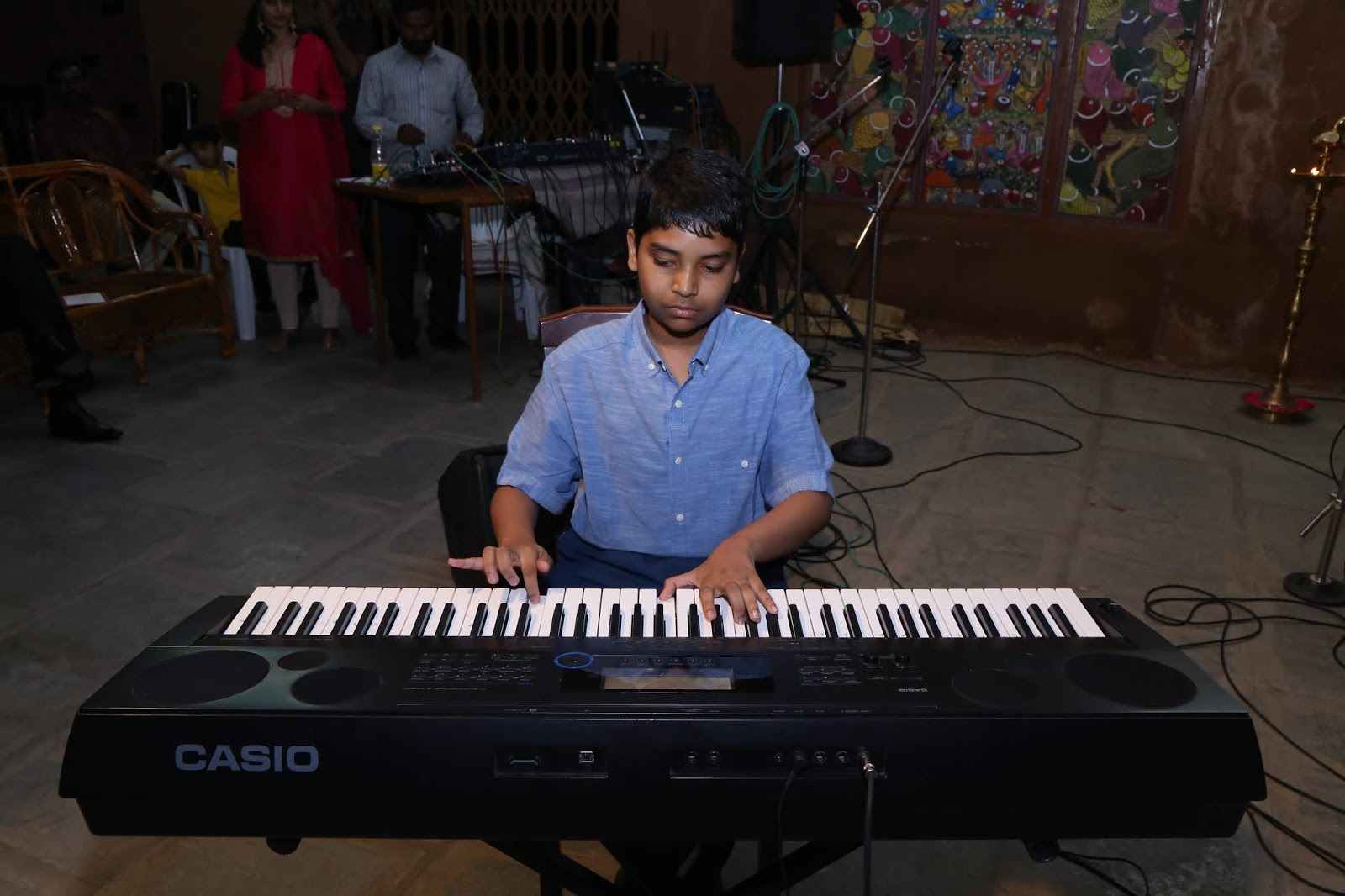
     Young K. Sudeep Kumar  showed his prowess on the keyboard by playing film music melodies to which he had programmed the accompanying orchestration.   
    
     A superb young pianist, Sai Manas Pandrangi, rendered the simple sounding, but difficult to play, Grande Valse Brillante Op. 18 – a composition for solo piano by Frederic Chopin. Sai Manas played on a Keyboard without reading the score and brought out the elegance of the composition. It was truly well performed. How much better it would have been if he played a real piano. One hopes that he pursues music further as he takes himself to the very high level that he seems capable of. 


The students of Ashrita D’Souza ‘Strings & Tunes’performed a blend of jazz, pop music & Western classical and pieces from musicals and animated movies. A few songs were done by a chorus, and the rest were solo’s by Ashrita’s students, and though the fare varied, it was Ashrita’s own performance of that stood out, for both, her beautiful and warm voice and her musicianship.

     The next two acts were by professional musicians, and they were outstanding in every way.

     Ruma Sengupta, is a Hindustani classical singer specialising in Thumri and Rabindra Sangeet. This singer was so good that we treasured every note that floated out of her so effortlessly, with such feeling, that we felt the sentiment of the music without understanding the words. Ruma Sengupta’s session made deep impact on the audience, but it ended too soon, we thought. She played the harmonium while singing, and was accompanied by an excellent tabla player.


     The last to perform was Soham Pal, singer -
the accompanists were themselves superb musicians on keyboard, percussion and Bansuri with Soham himself playing ‘Khamak’ or ‘Anand Lahari’ while singing. This unique instrument is a percussion instrument that also produces a melody. 

So this band of musicians performed Soham Pal’s own wonderful music that is an amalgam of Baul music and the folk music of Bengal and also Robindro Sangeet. Interestingly, Rabindranath Tagore’s compositions were also influenced by the mystic Baul musicians of Bengal. This was a magical performance that, like Ruma Sengupta’s, ended too soon. But that’s all there was time for! And we all had to go home.
     But as we went our way home, there was music abroad in the air, and we were awash in the warm feeling of satisfaction - in our own sacred spaces.


Monday, 25 June 2018

WORLD MUSIC DAY 2018. VIDYARANYA SCHOOL. WHAT A TIME IT WAS... IT WAS

     Listening to live music on a Sunday morning is as blissful as life can get, and bliss is the word that best described what the audience at Vidyaranya School felt on the 24th of June 2018; the day Hyderabad celebrated World Music Day.  
     And what a delightful variety of music we heard by a bunch of talented young people who kept us entertained and joyously engaged for two and a half hours. And before we forget to do so, we must thank Nandini Rao of Vidyaranya School, and Joe Koster of the Hyderabad Western Music Foundation (HWMF) for putting together the flawless programming and organisation of this lovely event, and bringing to us in the audience this plethora of local talent that is otherwise not seen, heard, recognized or acknowledged.
     This was definitely the high point of an eventful year that celebrates 10-years of HWMF and its concerts that brought together musicians, listeners, music teachers and has created 
a forum for intercultural musical exchange, and provided a performance platform for local and non-local musicians in a series of concerts and workshops with the sincere belief that music has the power to unite people, propagate pluralism and create Harmony through music.
    
     The first group of twelve young musicians to perform were the ISH Vocal Studio “La Voce” ISH stands for International School Hyderabad and these were students of the school, and they were directed by Iryna Tsarenko along with vocal coach Kathy Coard. They performed nine songs culled from musicals, displaying their skills, singing solos with choral backing, and singing in harmony as a chorus.

     The next to perform, and was perhaps, to some, the most supremely talented pianist of his age, or any age. 12 year old Yash Agarwalwho played Sonata in B Minor K 27 by D. Scarlatti, showing fluent skill and musicianship way beyond his years. He was joined by his 8 year old sister, Kashviand they both played 'four  hands', the Allegro from Sonata in C major by W. A Mozart.     

    A group of six, ‘Care & Love Strings’, and their teacher Abhijit Gurjale played some traditional English fiddle tunes, ‘Hunting the Hare & the Fairy Dance’ and also a Minuet by J.S. Bach.  

     Abhijit Gurjale followed this by displaying his finesse on the violin; playing ‘Pugnani Kreisler-Preludium and Allegro’. His beautiful bowing and rich full, smooth sound was world class. He followed up this Western classical piece with Carnatic classical music in which he is also proficient, and it was, to a knowledgeable member of the audience, the first time that he had heard Carnatic music played on the violin with such a gorgeous tonal quality, and with such great understanding of the music.


     Twelve year old Saachi Chennur, accompanied by her sister Sarika Chennur on violin, sang ‘Someone Like You’ from the musical Jekyl and Hyde, her vocal ability, her voice, and interpretation of the song, displayed vocal maturity beyond her years. This was another great revelation of local talent, and what became another talking point during homeward bound discussions of the mornings music.       

Hyderabad Youth Ensemble was next, the 17 member group including the music director Joe Koster, comprised 5 violinists, one cello, a flute, a clarinet, tenor and alto saxophones, two trumpets, two trombones, bass, guitar and drums. And, as Nicole, the Flautist, said, the ensemble comprised of not just the young, but also the young at heart. 
     It was so good to see and hear an ensemble of this sort, possibly for the first time in Hyderabad in many years, and it was such a pleasure to hear this rousing music from the musical /movie ‘Les Miserables’ played with such gusto and zest that was transmitted to the audience that lapped it up with relish.


    Nina Cherla was next, this young lady sang a good competent version of the song ‘One Moment in Time’ accompanied by the Hyderabad Youth Ensemble.


Clayton Sheehanmusic teacher, and superb musician that he is, sang in his mellow and soothing baritone, a very personal and peerless version of the song written by Paul Anka and made famous by Frank Sinatra, called ‘My Way’. He was ably accompanied by the Hyderabad Youth Ensemble. 


     The final act of the day at Vidyaranya School, was Deccan Voices in collaboration with Octafret Music academy, who did a medley of ABBA songs as from the movie Mama Mia. The 23 member chorus of sopranos, altos, tenors and basses was accompanied by bass guitar, drums, guitar and directed by Joe Koster from the piano. The fun songs were sung with enthusiasm, good harmony and balance.
     But their version of ‘Joyful, Joyful’ was a fitting end to the day’s programme, this song partly based on Beethoven’s symphony No. 9, but arranged for the movie Sister Act 2, was performed in a lively rendition that left us in the audience feeling good about having spent a wonderful morning suffused in music that fortified us for the day ahead.   

Monday, 5 March 2018

TINCTURES - AMAN MAHAJAN - PIANO/ NISHAD PANDEY - GUITAR

ORIGINAL MUSIC FOR PIANO AND GUITAR
Concert organised by Hyderabad Western Music Foundation
(first of a series to celebrate the 10th year of HWMF)
At Alliance Francaise Hyderabad on 3 March 2018

      The concert was like a series of controlled conversations between two good friends who happen to be very intelligent; who discussed their thoughts, feelings, and ideas respectfully and openly on a variety of subjects. They asked and answered questions and exchanged news and information in a way that was civilised and engaging.
     And the conversations were conducted by Aman Mahajan and Nishad Pandey, two creative musicians - in the medium of music.
     It was like two people talking to understand each other, and to create shared meaning.     There was no flirty banter or malicious gossip, arguments, debates or awkward silences, yet there was humour and a lightness of touch to the conversations.
     And what were the conversations about? Well, they were about real and imagined
worlds; a pastiche of sounds from Indian and European music; they created musical conversations and improvised on subjects, pictures, and Zen like tales, they made up melodies on the spot, they entered uncharted and varied terrain and met creatures of those areas, they explored rhythmic patterns and developed themes around them, they conversed about machines communicating with one another, and they played a lullaby for a snake.
     And though the music was very listener friendly and melodious, the music was also very
complex, in the sense that this music could be played only by very advanced musicians who were also extraordinarily proficient at their instruments and had a deep understanding of the theory of music; of compositional technique, of improvisation, and who have systematically studied music.     
      The various techniques that they employed in making the music they made and yet keeping it simple sounding enough for the audience to enjoy as much as we did was the work of genius. And that’s what they were.
     To give you a few examples of what they did, without us realising it:
     In one tune, ‘Patterns’ both the musicians played circular palindromes, i.e. they played musical phrases that are the same played forward and back. Like the word Malayalam, or the sentence ‘was it a rat i saw’, they are the same forward or back. In the same tune, they played these circular palindromes to what is equivalent to a rhythm cycle of 9 beats which was also a circular palindrome.
      In “See you in Berlin” they together harmonised a phrase inspired by Indian music.
      In another tune they used a ‘phasing compositional technique’, where both the instrumentalists play a phrase of music repetitively but in different tempos. Varying the tempos or the tune very slightly but perfectly coordinated, and though simple sounding, and minimalistic it demands a great deal of musicality, musical expertise and intense concentration to do this.
      In one tune, ‘Simple Machines’ they cross phrased chord progressions, this too is not as simple as the tune sounded, and it was a very appealing tune too, in this they juxtaposed simple chords with unusual rhythmic cadences in untraditional ways, more or less like counterpoint, so one could say that they re-harmonised the melody elaborately as only jazz musicians can do to make it sound so good.

     In one of their pieces that was completely improvised; both the musicians  plucked a melody out of thin air and took off and conversed intelligently; it was based on a quote by Thich Nhat Hahn which said “In true dialogue, both sides are willing to change”, this held true for the whole concert, where both the musicians conversed in a true dialogue. Both listened to the other. Both the musicians put in their own point of view, simply, clearly and seamlessly. Both brought in interesting ideas which they formed and changed and agreed upon in a dialogue that was impressive.
     The Tinctures concert, the first in a series of concerts to celebrate the tenth anniversary of Hyderabad Western Music Foundation was always interesting to the audience, and to paraphrase 'Have I told You lately...' by Van Morrison, Aman & Nishad filled our hearts with gladness, took away our sadness and eased our troubles - that's what they did.

Photographs: Joe Koster 

Wednesday, 21 February 2018

HAIKU POEMS AND INTERPRETIVE DANCE


Happy streak of luck
Haiku and expressive dance
A blissful evening
     It was an evening of haiku poems and interpretive dance. Besides making me experiment with poor unpoetic haiku to capture the pleasurable experience of listening to Kala Ramesh present her own haiku poems, Sunday the 18th of February 2018, at Our Sacred Space, took me on an aesthetic journey way beyond my own reckoning. 
     The graphic imagery of the poetic form of haiku and the impressionistic dance of the three Bharata Natyam dancers, Vrushali, Rama and Manasi sensitively interpreted their visual impression of the haiku in well imagined and choreographed dance, capturing with empathy the allusive imagery of the five elements on which Kala Ramesh’s haiku poems were based.
     Haiku, as we thought it was, was supposed to be a poem in three lines in seventeen syllables or less. But most of what I listened to was much shorter than seventeen syllables. I counted. But the haiku worked. They were authentic haiku. The poems were graphic and inspired and they made me see and think and imagine (this is after I had stopped counting the syllables and gave up my presuppositions). And how well they were expressed!
     Kala Ramesh had divided her poems as from her book of haiku and haibun, ‘beyond the horizons beyond’, into five sections, ‘Panchabhutas’ the five elements. Ether (akash) associated with sound. Air (vayu), sound and touch. Fire (agni), associated with sound touch and sight. Water (jalam), sound, touch, sight and taste. Earth (prithvi), sound, touch, sight, taste and smell.
     Kala Ramesh read a few of her haiku and haibun from each of these five sections of her book. Her poems were supraliminal, evoking within us a response above the threshold of sensory awareness, so our own imagination could take us to the spaces that went beyond the brink of perception while her words acted as guidelines.
     And during the reading, to delineate the space between the haiku, so that we knew that a new haiku was being read, a brass bowl was ting’d like a bell by one of the dancers, this heightened the experience of listening.
     Kala Ramesh’s poems were graphic and clear, and some were tacit and connotative, but all were thoughtful, elegant and expressive. Here are few examples.
From Earth: Prithvi

                    his outstretched hand
                         pins that perfect note...
                    nirghuni bhajan                           
                                     for Kumar Gandharva

                    spotlight ...
                    from within he draws
                    a lilting step
                         for Kelucharan Mahapatra
From Water: Jalam

                     monsoon!
                     the road home
                     rushing to meet me

From Fire: Agni 


                   long day
                   a lizard up a brick wall
                       a limb
                            at a time  

     But the Bharata Natyam dancers, Vrushali, Rama and Manasi, all from Pune where Kala Ramesh lives too, were no less than Kala Ramesh’s haiku in their interpretation of the five elements. 
     Their dance was artful, their movements graceful, and the choreography was creative, intelligent and supremely artistic. The perfectly chosen colours of their costumes; their impressions-in-dance of water, fire or air; their flawlessly synchronised movements; their use of space and time completely coordinated while they danced to music that they had selected that went so well with the intention of the theme. It was so memorable that one couldn’t easily get it out of one’s mind.
     Some of the music they had chosen was - for the opening, a serene piece on flute by Pravin Godkhindi. For Agni, they had chosen a piece called ‘Space’ by Zakir Husain, they had also used a piece by Vikram Ghosh, called ‘Grasshopper’, and then ‘Vande Mataram’, as superbly interpreted by Revathi on violin. Vrushali, Rama and Manasi made a huge impression for their clever, sharply defined interpretation of Kala Ramesh’s ‘haiku of the elements’. Yes it was a memorable evening.
     The best things happen by happenstance
     haiku & imaginative dance
     a rejuvenating renaissance

Photographs: Vikram Chunduru


Thursday, 7 December 2017

2ND INTERNATIONAL HYDERABAD JAZZ FESTIVAL 2017

     This year the Hyderabad Jazz Festival was on two days at two different venues.
     The first day 2nd of December 2017, it was on the lawns of the Secunderabad Club. And the second day, 3rd December, it was at the amphitheatre of Phoenix Arena.
DAY ONE
     The 3 bands that played at the Secunderabad Club on the 2nd, were a study in contrasts. They played music that was so different from each other that even the least knowledgeable about Jazz could hear the difference and know what dissimilar forms jazz could take. From a classical hued set by CRUISE CONTROL ON TRIO (CCO3) that amalgamated elements of jazz-like swinging rhythms and improvisation with classical guitar compositions to make music of an unusual, though transcendent, texture and tonality, to THE BEER PUPPETS, who twisted R&B and Neo Soul - itself an interesting mix of contemporary soul music and Rhythm and blues - with interesting arrangements and improvisation to make it ‘Jazz’ that appealed to hard rock fans in the audience. And sandwiched in between these two contrasting bands was the MATTEO FRABONI "EUROPE MEETS INDIA" QUINTET whose contemporary compositions, arrangements and concept of an unusual quintet sound mixed well with mainstream jazz to create a unique set of driving Jazz that stimulated the mind, body and spirit.

     CRUISE CONTROL ON TRIO (CCO3) – comprising Martin Van Hees - Classical Guitarist & Composer, played a classical acoustic-electric guitar for this performance. Aktas Erdogan - Classical/Jazz Guitarist, multi-instrumentalist & Composer, played a double neck electric guitar with one neck fretless; he also played Turkish flute and an Armenian Duduk. Nello Biasini – Percussion, played a regular drum set.
     All three conservatory trained musicians played a set of not just their own compositions, but music from the classical world and from jazz and pop. It was wonderful to hear such quiet, aesthetic and thoughtful music that balanced confidently between classical music and Jazz.  So the audience were charmed to hear besides the bands own compositions, ‘Fragile’ by Sting, ‘Someday My Prince Will Come’ from the Disney Movie ‘Sleeping Beauty’ that had been turned into a Jazz standard by Miles Davis and played as a solo in classical guitar style with a Jazz swing and improvisation by Martin van Hees. It was also so gratifying to hear a tango in a jazz concert, but that’s what we heard in the band’s ‘Tribute to Astor Piazzolla’ the Argentinian musician and composer, or to hear Cuban rhythms in a composition by Leo Brouwer of Cuba. To hear the surprisingly horn-like, plaintive sound from the tiny Duduk played by Aktas Erdogan in his own beautiful and sadness tinged composition and also in their composition called ‘Waltz for Duduk’, was an extraordinary experience. There were many pleasing moments while the trio played; and throughout, the drummer Nello Biasini was impeccable, everything he did was just right. So creative and such a perfect fit, it was delightful to hear a drummer who was so wholly coordinated and played so appropriately for this singular crossover between Jazz and Classical music, Cruise Control On Trio (Cco3).
     MATTEO FRABONI "EUROPE MEETS INDIA" QUINTET, as described, is a coming together of the artistes from Europe & India. And the music they played was a "voyage" through jazz, classical, Latin and Indian influences, led by the Italian drummer and composer Matteo Fraboni. The rest of the quintet comprised Sharat Srivastava – Violin who has been performing Hindustani classical music for over 25 years and was in the Indian rock band, Parikrama. Rainer Pusch is an internationally renowned saxophonist, flautist, arranger and composer. Aditya Jayakar on Piano is also a composer from Mumbai and performs with jazz musicians in Mumbai. Abhinav Khokhar is a one of the few upright bass players in India who has been collaborating and composing with many Indian and international musicians over the years.
     The closest one comes to describing the music that this quintet played is to say that it was a startling revelation of Jazz as an intercultural collaboration that was open to all influences. Not just that, it was inventive, and it was swinging.


     Most of the compositions were by Matteo Fraboni except two, and one of them, ‘Jai Ho’ was arranged so that it was transformed into an extraordinarily lovely work of art. Matteo Fraboni’s composing and arranging talent is brilliant. The compositions and arrangements were both emotional and intellectual in their appeal and incorporated all the Quintets instrumental diversities and yet was mindful of the player's individual "sound". The Quintet was professional to the highest degree, the quintet’s individual and collective improvisation was spot on. Sometimes the violin and saxophone blended so well that they sounded like the brass section of a jazz band. Violinist Sharat Srivastava’s solos were fresh, distinctive and very personal in tone and mood yet fitted the overall composition, and Aditya Jayakar on Piano was in tune with the feel of the band and took some good rapid fire solos. But it was Rainer Pusch who stood out as a 
colossal musician who bared his emotions through his alto saxophone, and flute, displaying exquisite technique, artistic expression and musicianship, playing energetic and expressive solos. It was soul satisfying to hear him. And Abhinav
Khokhar on bass was an ideal jazz bassist who thinks on his feet and harmonises and lays a solid foundation for the band. Of course Matteo Fraboni is a versatile drummer who plays an array of inventive swinging, syncopated rhythmic patterns to support the band, and a point to note is, though he is the leader, composer and arranger of the quintet, he is restrained and does not give himself too much prominence, but remains an unobtrusive accompanist. Both the bassist and the drummers’ solos were well conceived and constructed. 
     Amongst Matteo Fraboni’s compositions was one called ‘Varda’, named after the cyclone that hit Chennai in 2016. Another was ‘The Society of Liquid Law’, and another called ‘Unknown Knowledge’. To hear this engaging Quintet was indeed a pleasure and a privilege.

      THE BEER PUPPETS set was full bodied, loud and appealed to the rock music lovers in the audience. Defining the music they performed at the Jazz festival is difficult. It could be called R & B, or it could be called Soul, or it could be called new form of rock, but it was performed with full-spirited energy and it could be called jazz too because there was a degree of improvisation. The guitar player Anthony Cammarota was versatile and surprisingly perceptive. Especially when he ‘comped’ behind the solos with interesting chords. But he played his solos sometimes like a shredding rock 
guitar player and sometimes as like a sensitive jazz guitarist. And of course there was Karim Ellaboudi on piano who is more a Jazz pianist than anything else, and it was his elegant, stylish and tasteful playing that made the music rise above itself. Shreya Bhattacharya’s is a gifted vocalist, her voice a powerful and supple instrument with which she belted out some fiery vocals. The bassist, Abhishek Dey, was the force to be reckoned with, it was he who was the drive behind the music, and his bass playing was outstanding as was  his understanding of the music. And the drummer, Aron Nyiro’s musical intelligence was obvious, he has a wonderful sense of tune, tempo and dynamics and his technique and stick work and his ability to use every part of the drum set with telling effect was incredible. So while The Beer puppets music was hard to define as jazz, it was good music that could be only be played by Jazz influenced musicians.
     It was an evening of fine music that was enjoyable, refreshing and artistic.  And appealed to the senses and to the soul.

DAY TWO
     Day Two. 3rd of December 2017, Phoenix Arena, Hyderabad. This was the day of atmospheric, imaginative, experimental music in the amphitheatre that was suitably bathed in the luminous glow of a full moon.
     UNDER THE SURFACE from Netherlands, comprised the leader, Joost Lijbaart, who played Drums & Percussion, Bram Stadhouders, Guitar & Electronics and Sanne Rambags, Vocals & Lyrics. 
The trio’s music seemed experimental, but was actually loosely structured to give each musician room to listen and respond. One could tell that Joost Lijbart was a skilled jazz drummer who kept control over the pieces that were played and kept the trio within the structure of the music, and Bram Stadhouders on acoustic-electric guitar provided the melodic hooks on which the remarkable young singer Sanne Rambags improvised using her voice as an instrument. Under The Surface played what sounded like open and experimental music, but was, in reality, precise, controlled and atmospheric, and the music gave the impression of it being balanced between magic and reality. The bands profile very aptly described their music as a “search for space through silence and improvisation”.
     C.A.R. is four young musicians from Koln, Germany, Leonhard Huhn on alto saxophone, bass clarinet and effects, he pushes the boundaries of music by creating a delicate web of sound heavily altered by electronic effect devices. And Christian Lorenzen who plays Piano and Synthesizer is one of Germany´s flagship jazz musicians, Kenn Hartwig on acoustic-electric Bass is equally, or more at home with electronics and researching the world of sound. And Johannes Klingebiel on drums plays many genres of music but more of Techno and Deep House.
     The four musicians of C.A.R. concocted a brew of musical sounds that incorporated jazz, experimental music and free improvisation that, as someone said, “carries you away like a cloud”. 
 ERIK TRUFFAZ & RIATSU, ANAND BHAGAT & NEIL GOMES
The Erik Truffaz headed outfit played their set of exotic music last. Erik Truffaz lyrical and melodious trumpet lines were played over looped repeating patterns of sounds from his own trumpet, similar to an elephant trumpeting, and these sounds were sometimes draped over a grating factory-floor like groove, or sometimes to more atmospheric dreamlike groove similar to what Miles Davis experimented with and was ‘done with’ towards the end of his life. Comparing Erik Truffaz and Miles Davis is not far-fetched, because Erik Truffaz does play his trumpet with the same spare, thoughtful, melancholic feel as Miles Davis, but in this concert these are patched on to textures and atmospheres created by his band. Riatsu, who composes ambient techno to dark ambient electronic music.  Anand Bhagat percussionist known for his skills with the West African Djembe and who played the Didgeridoo too for some of the more exotic soundscapes, and multi Instrumentalist voice and guitar player Neil Gomes. However experimental the music may have sounded to an audience, Erik Truffaz music and the sound of his band, though out of the ordinary, is still engaging and interesting.
     All in all, it was an extraordinary two days of music. The music was quite unusual, often on the thin edge of Jazz, but it was a wonderful experience to listen to such diverse sounds and such a diverse range of music from an array of great musicians, every one of whom believed in what they were doing and gave us in the audience everything they had with holding back.
     The 2nd Hyderabad International Jazz Festival was conceived, coordinated, and made to happen through the sole effort of the one man band, Joe Koster, of course, with a whole lot of help from friends and institutions such as Hyderabad Western Music Foundation, Goethe-Zentrum Hyderabad, Alliance Française Hyderabad, US Consulate, Secunderabad Club, Phoenix-Arena and a few sponsors and donors.
Pratap Antony /hydmusic.com / 7th December 2017   Photographs: Joe Koster